 |
| source: http://www.underconsideration.com/brandnew/ |
Wednesday, July 28, 2010
New Packaging
We have shed the default style and put this blog in a new packaging!


Tuesday, July 6, 2010
Anish Kapoor - Grayman Cries, Shaman Dies, Billowing Smoke, Beauty Evoked.
Some months ago we showed our first print tests with little square and round objects to a friend of us and she pointed out that it really looked like a scale model of a recent artwork by Anish Kapoor: Grayman Cries, Shaman Dies, Billowing Smoke, Beauty Evoked. While we do know most of the work by Kapoor (you might know him from his turbine hall installation at Tate Modern) we hadn't seen his latest work yet. Looking at the images below you can probably imagine our surprise when we looked it up. That does indeed look like extruded slurry deposited with a 3d printer! In fact it is concrete and after googling some more we found the company Factum Arte that pulled this together. Factum Arte is a workshop based in Madrid that works with major artists and institutes on the production and conservation of artworks using various techniques like 3d-scanning, 3d printing, milling etc. They documented the process very well on their website here and here. You can also find all the movies on their Vimeo
Lovely quote: The Identity Engine is a shit machine that farts and craps its way along its ordained path, transforming concrete into stigmergic, self-organised structures. Wounds and gashes, pleats and folds emerge at will and either self-heal or continue to rupture. (excerpt from Unconformity and Entropy)
Some observations:
-We would really like to know more about pumping systems. While a frostruder style syringe head works as a proof of concept printhead for testing materials and software settings, it is not a good solution for producing useful objects because you are very limited size wise in what you can print without swapping syringe, a procedure that brings a whole lot of problems with it. The first step will be trying a larger reservoir on the side, something like an electronic caulking gun. But we need to brainstorm with some more people on this, time for a forum thread!
-Delcam software is used to drive the printer.
-In one video a little piece is mounted on the nozzle to smear all the slurry that rises above the nozzle output, smart because in our experience the quality of the print decreases if there is material piling up around the nozzle.
-Its not printing continuously, they can start/stop the output fast. No idea if this is done by the pumping system or with a valve at the nozzle.
-Support material is sand thrown in by hand, funny :)


Thursday, June 24, 2010
Back
Our machine is finally back in the studio for a longer time so expect some updates. First experiences with glass for example. Stay tuned.

Last week we gave a talk and demo in Basel at Hyperwerk. Hyperwerk is an institute for post-industrial design (love that title) and feels like a large fablab/hackerspace but one where you can get a bachelor degree :)
They will start using a Frostruder and Makerbot for printing all kinds of material including ceramics. Besides a Makerbot they have a Mendel, ShaperCube and immediately ordered a RapMan after seeing ours. I am looking forward to their results!

Hyperwerk chief Mischa looking at a CNC styrofoam cutter
Thursday, May 13, 2010
One exhibition, two repraps, lots of other great projects.
It has been quiet for a while, not because we weren't working but the opposite :) So expect a few posts in the coming days.
What was taking our time? Art centre Z33 in Hasselt, Belgium commissioned Unfold to create an installation 'featuring a 3d printer' for the exhibition "Design by Performance". The Installation is called L'Artisan Electronique and combines traditional pottery craft with 21th century digital techniques. Its still on display till the end of May. If you happen to be in the neighborhood, we will be operating the printer the 29th of may.
From the catalogue:
The world of design has been witness to how the boundaries between art and experimental design are becoming ever more blurred. The exhibition ‘Design by Performance’ is a showcase for performative trends in contemporary design, which focuses not on the production of a finished product, but on the production process itself: objects whose realisation is a continuous project, affected or formed by either the environment, the specific situation in which they find themselves, or onlookersAs such, processes and performances constitute a crucial part of Design by Performance, thus lending the exhibition its unpredictable and spontaneous character, and converting what is otherwise a pure ‘exhibition space’ into a space for events, interventions and actions by designers, artists and the public.
Participants
Atelier NL (NL), Maarten Baas (NL), Pieke Bergmans (NL), David Bowen (USA), Oscar Diaz (UK), Edhv (NL), Front (Sw), Martino Gamper (UK), Simon Heijdens (UK/NL), Eric Klarenbeek (NL), Sofie Lachaert & Luc d’Hanis (B), Laurent Liefooghe (B), Lawrence Malstaf (B), Bruno Munari (IT), Markus Schinwald (Au), Studio Glithero (UK), Studio Libertiny (NL), Tjep. (NL), Unfold & Tim Knapen (NL/B)
For L’Artisan Electronique, Unfold created - aside from the ceramic printer you all know - a virtual pottery wheel in collaboration with Tim Knapen. This pottery wheel gives visitors a chance to ‘turn’ their own forms. At regular intervals, a selection of these designs is printed in clay and exhibited in the space.
In L’Artisan Electronique, pottery, one of the oldest artisanal techniques for making utilitarian objects, is combined with new digital techniques. The virtual pottery wheel was realsied by means of a 3D-scanner and digital design software. However, the installation still clearly refers to the artisanal process of working in clay. The printing process imitates the traditional technique used by ceramicists, in which the form is built up by stacking coils of clay.


The other Reprap on display is in David Bowen's Growth Modeling Device that has been featured on a few Reprap blogs in the past. Its a fantastic piece that copies a growing union plant at regular intervals. David, who together with his wife also happen to be wonderful people, build his own Darwin style printer using a Makerbot extruder and gen2 electronics. The fun thing is that the printer has no top frame and is still very stable. I think he did a better job at integrating the Reprap technology in his installation than us, we didn't try :) More info at http://www.dwbowen.com/gmd.html


What was taking our time? Art centre Z33 in Hasselt, Belgium commissioned Unfold to create an installation 'featuring a 3d printer' for the exhibition "Design by Performance". The Installation is called L'Artisan Electronique and combines traditional pottery craft with 21th century digital techniques. Its still on display till the end of May. If you happen to be in the neighborhood, we will be operating the printer the 29th of may.
From the catalogue:
The world of design has been witness to how the boundaries between art and experimental design are becoming ever more blurred. The exhibition ‘Design by Performance’ is a showcase for performative trends in contemporary design, which focuses not on the production of a finished product, but on the production process itself: objects whose realisation is a continuous project, affected or formed by either the environment, the specific situation in which they find themselves, or onlookersAs such, processes and performances constitute a crucial part of Design by Performance, thus lending the exhibition its unpredictable and spontaneous character, and converting what is otherwise a pure ‘exhibition space’ into a space for events, interventions and actions by designers, artists and the public.
Participants
Atelier NL (NL), Maarten Baas (NL), Pieke Bergmans (NL), David Bowen (USA), Oscar Diaz (UK), Edhv (NL), Front (Sw), Martino Gamper (UK), Simon Heijdens (UK/NL), Eric Klarenbeek (NL), Sofie Lachaert & Luc d’Hanis (B), Laurent Liefooghe (B), Lawrence Malstaf (B), Bruno Munari (IT), Markus Schinwald (Au), Studio Glithero (UK), Studio Libertiny (NL), Tjep. (NL), Unfold & Tim Knapen (NL/B)
For L’Artisan Electronique, Unfold created - aside from the ceramic printer you all know - a virtual pottery wheel in collaboration with Tim Knapen. This pottery wheel gives visitors a chance to ‘turn’ their own forms. At regular intervals, a selection of these designs is printed in clay and exhibited in the space.
In L’Artisan Electronique, pottery, one of the oldest artisanal techniques for making utilitarian objects, is combined with new digital techniques. The virtual pottery wheel was realsied by means of a 3D-scanner and digital design software. However, the installation still clearly refers to the artisanal process of working in clay. The printing process imitates the traditional technique used by ceramicists, in which the form is built up by stacking coils of clay.


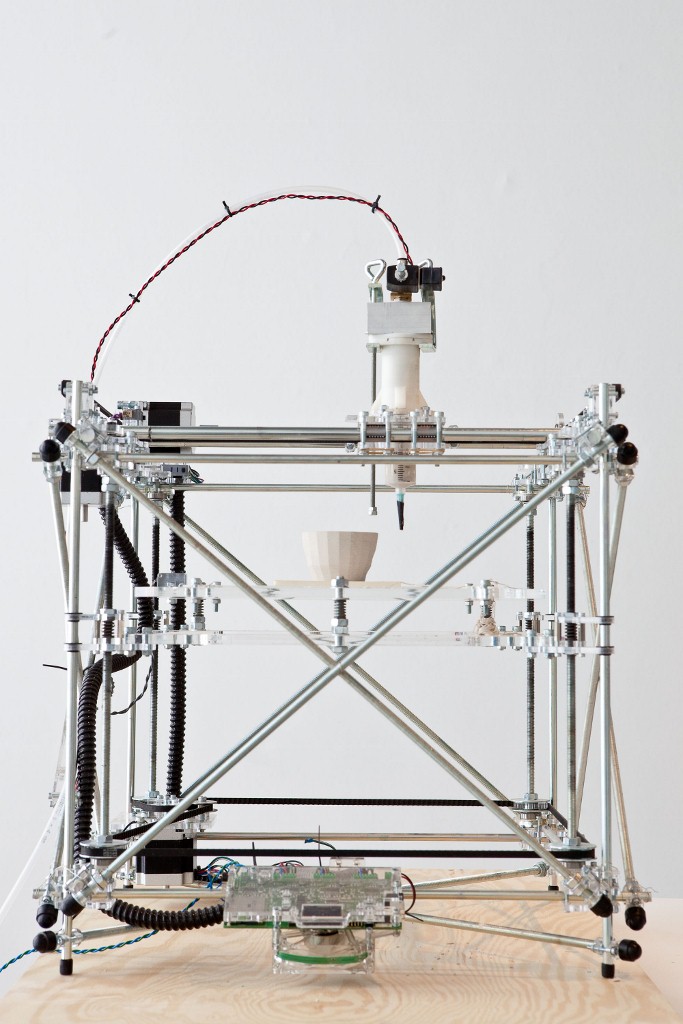

The other Reprap on display is in David Bowen's Growth Modeling Device that has been featured on a few Reprap blogs in the past. Its a fantastic piece that copies a growing union plant at regular intervals. David, who together with his wife also happen to be wonderful people, build his own Darwin style printer using a Makerbot extruder and gen2 electronics. The fun thing is that the printer has no top frame and is still very stable. I think he did a better job at integrating the Reprap technology in his installation than us, we didn't try :) More info at http://www.dwbowen.com/gmd.html
Friday, February 19, 2010
Hello Blogosphere
This blog was originally intended to share our progress with fellow reprappers in modifying a 1000$ Rapman to print clay. But this post was picked up by BoinBoing two days ago and spread to Wired, Makemagazine, Openmaterials, Switched and Open3dp. You've got to love the internet, yeah! We got lots of great responses, questions and emails. For the new visitors that missed the previous discussions in the Reprap forum here and here and some other places we decided to write a follow up on some of the comments and to clarify some things:
-Unfold Fab is a blog by spatial design studio Unfold, check our website to get an impression of what we do.
-We use a Rapman from Bits from Bytes which is an everything-in-on-kit version of the open source RepRap project. Highly recommended machine!
-We will present our research as part of the Designed by Performance show at Z33, Hasselt, Belgium. The installation L'Artisan Electronique will feature a Rapman with Claystruder and a virtual trowing wheel that scans 3d hand movements and generates virtual objects that will be printed at a later time. The installation is a collaboration with Tim Knapen. David Bowen will also show his Growth Modelling Device, a Reprap based installation. More on this show soon.
-Is this the first use of rapid prototyping/manufacturing technology in ceramics? No, definitely not and some bloggers understood the posts title as if this was the first printed ceramic vessel EVER in the history of mankind.... Ceramics has been made before using expensive rapid prototyping machines, there is the work of Marc Ganter's team from U of Washington and John Balistreri from BGSU. Both use Zcorp printers with modified binders and clay powders. Then there is Robocasting which uses a very similar technique to what we are doing: clay extrusion. Also the work done on large scale concrete printers has lots of overlap like Contour Crafting developed by Behrokh Khoshnevis or the concrete printer used by artist Ansih Kapoor made by Factum Arte. There was a post in the pipeline explaining why we are doing extrusion and how it compares to the powder/binder based process, we'll post that in a few days. But as far as I know this the first ceramic vessel done on a sub 1000$ rapid prototyper! :) I think Switched.com got it right as to the importance of this affordable hackable technology being in the hands of designers:
-Someone pointed out that it is technically not ceramics until it is fired and he/she was absolutely right but this is corrected as per the previous post ;)
-Can this be smoothed? Sure, dry greenware objects are very easy to sand or you can smooth them when still wet, many options and we'll do some tests on the next prints. We like the traces of 'making' on objects and thats why we left them rough.
-Unfold Fab is a blog by spatial design studio Unfold, check our website to get an impression of what we do.
-We use a Rapman from Bits from Bytes which is an everything-in-on-kit version of the open source RepRap project. Highly recommended machine!
-We will present our research as part of the Designed by Performance show at Z33, Hasselt, Belgium. The installation L'Artisan Electronique will feature a Rapman with Claystruder and a virtual trowing wheel that scans 3d hand movements and generates virtual objects that will be printed at a later time. The installation is a collaboration with Tim Knapen. David Bowen will also show his Growth Modelling Device, a Reprap based installation. More on this show soon.
-Is this the first use of rapid prototyping/manufacturing technology in ceramics? No, definitely not and some bloggers understood the posts title as if this was the first printed ceramic vessel EVER in the history of mankind.... Ceramics has been made before using expensive rapid prototyping machines, there is the work of Marc Ganter's team from U of Washington and John Balistreri from BGSU. Both use Zcorp printers with modified binders and clay powders. Then there is Robocasting which uses a very similar technique to what we are doing: clay extrusion. Also the work done on large scale concrete printers has lots of overlap like Contour Crafting developed by Behrokh Khoshnevis or the concrete printer used by artist Ansih Kapoor made by Factum Arte. There was a post in the pipeline explaining why we are doing extrusion and how it compares to the powder/binder based process, we'll post that in a few days. But as far as I know this the first ceramic vessel done on a sub 1000$ rapid prototyper! :) I think Switched.com got it right as to the importance of this affordable hackable technology being in the hands of designers:
With reasonably priced 3-D printers hitting the market, and DIY versions becoming more prevalent, we're now entering a very exciting time in which designers are experimenting with the materials they send through their extruders. We wrote back in November about Belgian design outfit Unfold and the Utanalog teapot it displayed at the Bits 'n Pieces Exhibition. Now, Unfold has successfully used its 3-D printer to print an earthen vessel from powdered ceramic material.-Its not powdered ceramic material as in the Zcorp process. Clay is a suspension of minerals in water and the Zcorp based system kind of makes clay in the print process by adding the binder. We use clay as a print material and we use clay powder just to make clay that always has the same consistency. Sounds high tech to some but this is standard pottery techniques.
-Someone pointed out that it is technically not ceramics until it is fired and he/she was absolutely right but this is corrected as per the previous post ;)
-Can this be smoothed? Sure, dry greenware objects are very easy to sand or you can smooth them when still wet, many options and we'll do some tests on the next prints. We like the traces of 'making' on objects and thats why we left them rough.
Successfully fired
We bisque fired everything at 1000°C and all tests came out of the kiln perfectly which is very encouraging. Air doesn't seem to be to much of a worry. Yes, those are Utah teapots :)


Sunday, February 14, 2010
The future's here baby! (first successfully printed ceramic vessel)
We took some time to play around and get used to the dynamics of the clay print process. It was also time to step up (or down?) the resolution from 1.9 to 0.8 mm using screw-on luer lock tips. We are also now using powder clay that can be mixed in exact quantities instead of moisturizing chunks of clay. Also figuring out ways of reliably filling the syringes without trapped air. I'm using a similar 60cc syringe where the front is cut off and use this to suck in the clay from the mixing bowl. Then the clay is transferred to the print syringe, this works really well actually.
Last weekend I talked briefly with Adrian Bowyer after his excellent talk at FOSDEM. I was excited to show him our results after he finished his talk with mentioning ceramics as future possibilities (hence the title, wink, wink)
Now lets pray all together that trapped air bubbles won't make it pop...
More images and video in our gallery [note 04-2015: gallery is gone)
ps. Sorry Erik for the missing reference, its 70 x 70 mm


Subscribe to:
Posts (Atom)